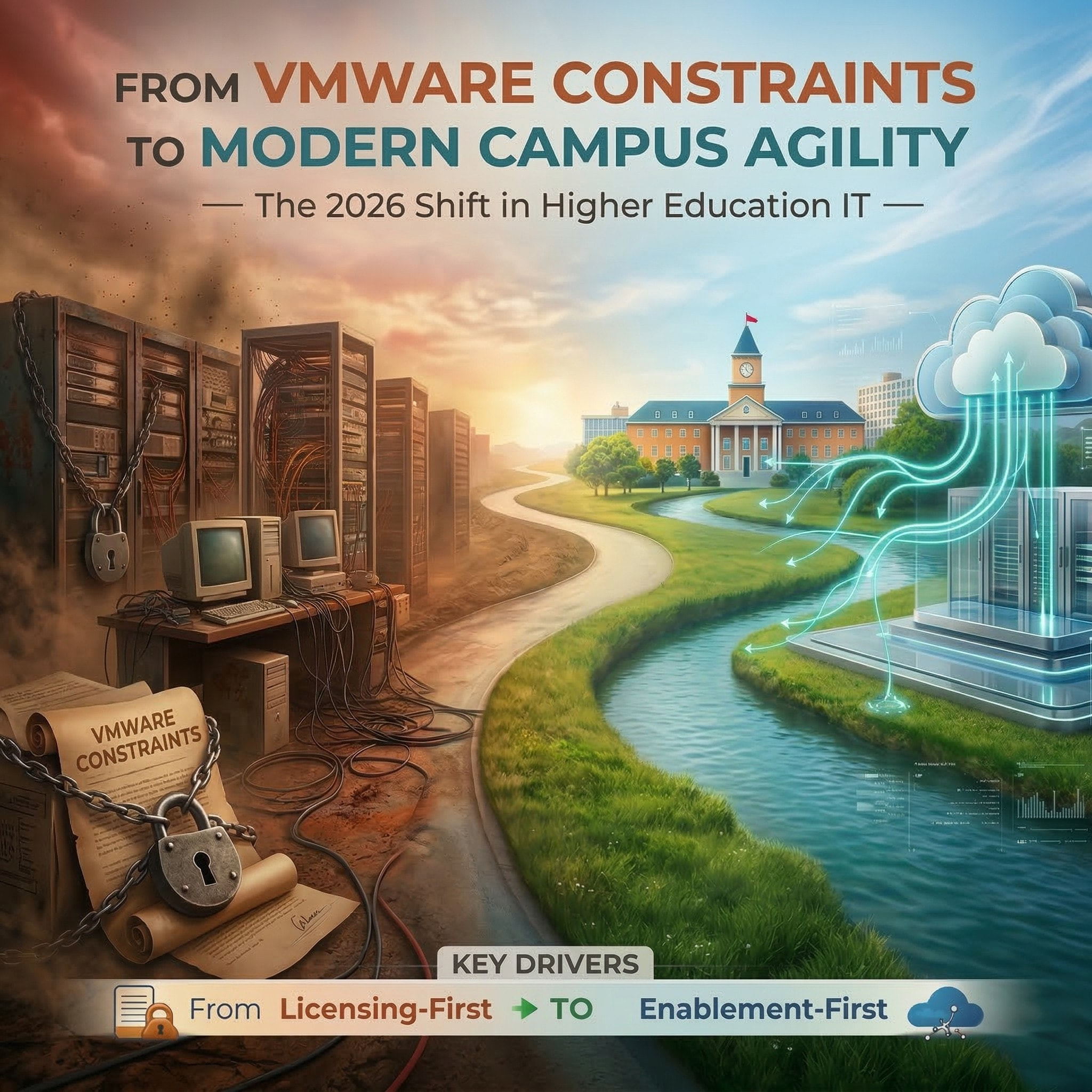
The End of the Legacy Virtualization Era
The centralized virtualization model built for a pre-cloud world is reaching its limits. Learn what this shift means for CIOs, CFOs, and business lea

Paul Shulman leads Anantyx with a clear vision: simplify AI and cloud management and empower every user.
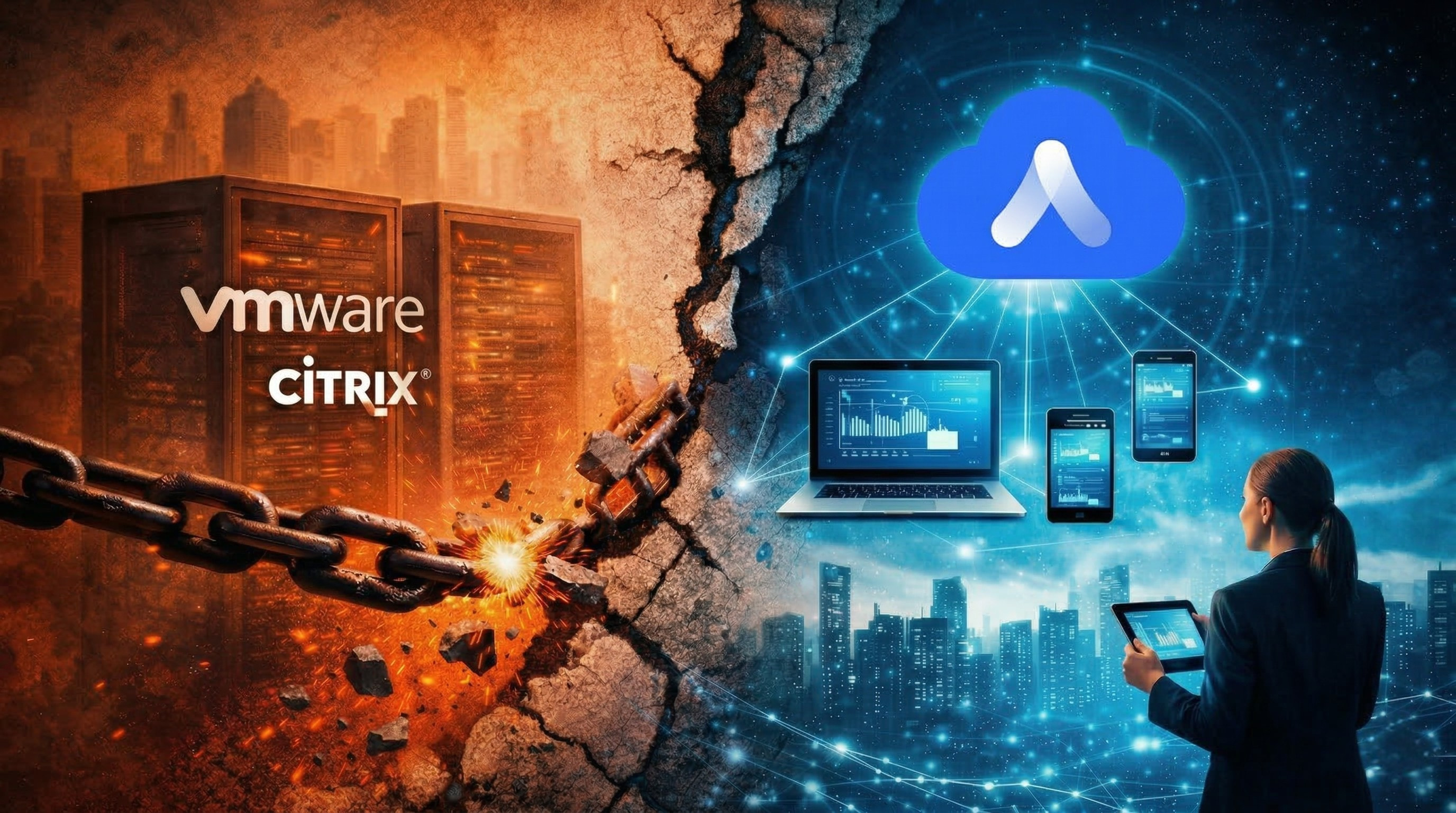
The End of the Legacy Virtualization Era
Why the Centralized, IT-Mediated Infrastructure Model Is Reaching Its Limits
TL;DR
- Legacy virtualization was built for a pre-cloud world - it solved hardware inefficiency, not business agility
- The real constraint today is provisioning speed, cost visibility, and workforce flexibility
- This is an operating model problem, not a vendor problem
- Organizations that recognize the distinction will modernize effectively - those that don't risk rebuilding the same bottlenecks in a new environment
For more than a decade, enterprise IT strategy was anchored in virtualization.
Platforms such as VMware and Citrix consolidated servers, centralized desktop delivery, and reduced hardware sprawl. They solved real problems in an era defined by physical infrastructure constraints and capital-heavy data centers.
Virtualization was not a mistake. It was the right solution for its time.
But the environment has changed.
Today's pressure is not about server density. It is about business agility, financial predictability, workforce flexibility, talent scarcity, multi-cloud complexity, and the rapid expansion of AI-driven workloads.
The centralized, IT-mediated virtualization model was built for a pre-cloud world. That model is now under structural strain.
This is not a vendor story. It is an operating model story.
What Defined the Legacy Virtualization Era?
The virtualization era rested on several assumptions:
Infrastructure is scarce and must be centrally controlled.
Provisioning required tickets, approvals, configuration, and administrative intervention. IT acted as the gatekeeper because hardware was expensive and finite.
Business users consume infrastructure, — they do not operate it.
Departments submitted requests and waited. Infrastructure interaction happened through IT, not directly within business workflows.
Centralization equals efficiency.
Shared VDI pools and hypervisors maximized hardware utilization. Performance variability and queue delays were accepted trade-offs for consolidation.
Access is device-dependent.
Virtual desktops required managed endpoints, specific clients, VPN layers, and structured device control.
Cost lives inside IT.
Infrastructure expense was aggregated and allocated broadly. Real-time visibility by department or individual was rare.
For years, this model worked.
But infrastructure is no longer a background utility. It is now embedded directly into daily business decision-making.
Business Velocity Is Now the Constraint
The most important shift is this:
Infrastructure no longer supports only engineering teams. It supports daily business modeling.
Consider the modern enterprise:
- A CFO running multi-scenario financial simulations
- HR modeling workforce restructuring or acquisition impact
- Marketing deploying analytics environments for campaign optimization
- Operations analyzing supply chain risk
- AI teams testing model variations
These are not quarterly initiatives. They are routine functions.
When provisioning cycles stretch into weeks, business modeling slows. When scaling requires tickets, approvals, and specialist intervention, agility suffers.
The expectation has shifted from:
“Submit a request.”
To:
“Launch what you need — safely — now.”
Speed is no longer an engineering metric. It is a business requirement.
Beyond Instant Provisioning: Self-Service and Device FreedomBeyond Instant Provisioning: Self-Service and Self-Device
Near-instant provisioning is only half the equation.
Modern business users expect two things:
- Immediate environment availability
- Secure access from their own device
If infrastructure requires:
- Managed hardware refresh cycles
- Specialized desktop clients
- Complex VPN dependencies
Then speed gains evaporate.
Workforce flexibility now depends on:
- Browser-native access
- Device-agnostic delivery
- Secure identity enforcement
- Policy-based guardrails
This shift reduces friction without reducing control. It also lowers the hidden cost of hardware lifecycle management and endpoint support.
The legacy virtualization model did not prioritize device independence. The modern operating model must.
The Real Cost Problem Is Larger Than Resource Spend
Much of the modernization conversation focuses on cloud waste and subscription pricing.
But the deeper economic issue includes four dimensions.
1. Staffing Overhead
Centralized virtualization requires:
- Platform administrators
- VDI specialists
- Ticket triage teams
- Manual provisioning workflows
- Performance troubleshooting
As complexity grows, staffing scales. Infrastructure cost is visible; mediation cost often is not.
When IT must manually translate business intent into infrastructure configuration, labor becomes a significant component of total cost.
2. Operational Drag
Manual provisioning introduces delay. Delay compounds.
Projects wait.
Temporary environments linger.
Scaling decisions slow.
Operational friction becomes normalized, but it erodes competitiveness over time.
3. Talent Concentration Risk
Specialized virtualization expertise is limited. Organizations dependent on platform-specific operators face:
- Hiring difficulty
- Salary inflation
- Knowledge silos
- Transition risk
Modern governance-driven models reduce reliance on scarce administrative specialists by embedding policy into the provisioning layer.
4. Delayed Cost Accountability
Legacy models often report cost after consumption. Modern financial management demands visibility before deployment.
Business units increasingly require:
- Pre-deployment cost estimates
- Budget guardrails at provisioning
- Real-time visibility by project or department
Without embedded cost governance, elasticity amplifies unpredictability. Without reducing mediation, staffing cost grows alongside infrastructure cost.
The full economic equation must include both.
Shared Infrastructure vs. Isolated Workloads
Traditional VDI and virtualization environments emphasize shared resource pools.
While efficient in theory, shared pools introduce:
- Performance variability
- Resource contention under peak load
- Concentration risk
- Broader blast radius during failure
As workloads become more graphics-intensive and AI-driven, predictability matters more than density.
Modern infrastructure models increasingly favor workload isolation, policy-based limits, and reduced interdependence. The philosophy shifts from maximizing shared utilization to maximizing performance stability and risk segmentation.
This reflects a broader evolution: infrastructure optimized for business outcomes rather than hardware ratios.
The Control Layer Has Moved
The most significant shift is not technical. — Iit is structural.
In the virtualization era:
- Control lived inside infrastructure.
- IT mediated requests.
- Cost was reviewed after deployment.
- Access was device-bound.
In emerging models:
- Control lives in policy.
- Guardrails are embedded at provisioning.
- Cost visibility precedes deployment.
- Access is identity-driven and device-agnostic.
Control does not disappear. It becomes programmable.
Infrastructure becomes a governed service layer rather than a manually administered gate.
This is the fundamental transition underway.
This Is Not About Replacing a Vendor
Virtualization technology continues to operate.
The question is not whether hypervisors still function. They do.
The question is whether a centralized, admin-heavy operating model built for a pre-cloud world aligns with the demands of 2026 and beyond.
Organizations asking the right question are not asking:
“Which virtualization platform should we standardize on?”
They are asking:
“How should business users safely and directly interact with infrastructure over the next decade?”
That question reframes modernization entirely.
A Practical Next Step
Modernization does not begin with migration.
It begins with assessment.
- How long does it take to provision a new environment?
- How many human handoffs are required?
- Can business units see projected cost before deployment?
- How much staff time is spent translating business requests into infrastructure tasks?
- How dependent are we on specialized platform administrators?
- Can users securely access environments from their own devices without added complexity?
These questions reveal whether the constraint is technology — or operating model.
Looking Ahead
In this series, we will examine:
- Why the cost structure of legacy virtualization is increasingly unstable
- The hidden staffing expense of IT-mediated infrastructure
- Why lift-and-shift migrations often recreate legacy bottlenecks
- The structural limits of shared VDI pools
- The rise of policy-driven, multi-cloud control layers
The virtualization era solved hardware inefficiency.
The next era solves business velocity, financial accountability, and governance at scale.
If your organization is reassessing its legacy virtualization footprint, the more strategic question may not be “What do we replace it with?”
It may be:
“What control model do we want for the next decade, — and who should it empower?”
_compressed.jpg)
_With%20Logo.jpg)